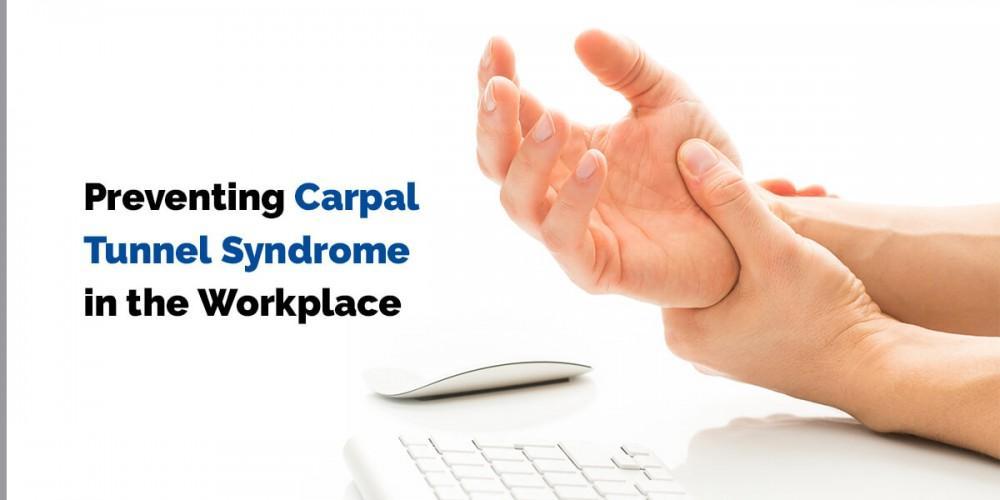
Hand and wrist pain can make it challenging to do your job. If you often perform repetitive hand and wrist movements — such as typing, using hand tools or sewing — carpal tunnel syndrome could be causing your pain.
What Is Carpal Tunnel Syndrome?
Your carpal tunnel is a small passageway that runs through your wrist and consists of tissue and small bones. The carpal tunnel protects the median nerve, which runs along your forearm to your hand. This nerve controls the muscles at the bottom of your thumb and creates sensations in your index finger, middle finger, ring finger, and thumb.
Carpal tunnel syndrome occurs when the passageway narrows, putting pressure on the median nerve.
Carpal Tunnel Syndrome Symptoms
Some telltale signs of carpal tunnel syndrome include:
- Pain, numbness, tingling or burning in your thumb, index, middle and ring fingers.
- Shock-like sensations in the wrist that radiate to the thumb, index, middle and ring fingers.
- Weakness in one or both hands.
- Dropping or fumbling things frequently.

How to Prevent Carpal Tunnel at Work
If your hands or wrists hurt at work, try taking these steps to reduce your pain:
1. Improve Workplace Ergonomics
Arranging your workstation to minimize strain and fatigue is crucial. Try the following adjustments to reduce pain and decrease your risk of developing carpal tunnel syndrome:
- Set your chair height for optimal arm position and wrist alignment.
- Alternate between sitting and standing to avoid keeping your hands in the same position all day.
- Use a wrist support pad with your keyboard or mouse.
2. Do Stretches and Strengthening Exercises
Taking a few minutes to stretch and strengthen your wrists every few hours can help prevent carpal tunnel syndrome. Some common wrist and hand exercises include:
- Clenching and unclenching your fingers.
- Rotating your wrists.
- Holding your hands in front of you in a “stop” position.
3. Be Mindful of Your Grip
A tight grip can contribute to carpal tunnel syndrome. Whether you’re holding a pen too tightly or gripping a screwdriver intensely, exerting extra force for hours a day can add pressure to the median nerve. Be aware of your grip and loosen it when necessary to help alleviate carpal tunnel syndrome symptoms.
Carpal Tunnel Syndrome Treatment Near Nashville, Tennessee
The carpal tunnel specialists at Elite Sports Medicine and Orthopedics can help you recover from the syndrome. We recommend a personalized treatment plan, which may include splints, braces, medication, physical therapy, or surgery in severe cases.
Schedule a consultation with us today.


Author: AMWN Dev
Related Articles

Elite Sports Medicine + Orthopedics is proud to welcome William B. Gilbert Jr., M.D., to our growing team of orthopedic specialists. Dr. Gilbert is a [...]

Elite Sports Medicine + Orthopedics is proud to welcome Mihir J. Desai, M.D., FAOA, to our growing team of orthopedic specialists. Dr. Desai is a [...]

Recovering from a sports injury can be about more than returning to competition. It can shape the course of a person's future. For former Belmont [...]

We are proud to share that ten of our physicians at Elite Sports Medicine and Orthopedics have been named Nashville Top Doctors by Castle Connolly [...]

Thumb arthritis can make everyday tasks like opening jars, turning keys, gripping objects, and pinching painful and frustrating. For patients with advanced thumb arthritis who [...]

Shoulder pain is one of the most common reasons patients visit a sports medicine specialist or orthopedic doctor. It affects athletes, active adults, and [...]

Joint pain is one of the most common health complaints across all age groups. Most everyday aches improve with rest, ice, or over-the-counter medication—but sometimes [...]

When athletes think about improving performance, the focus often lands on strength training, conditioning, and skill development. One critical factor is often overlooked: foot health. [...]

When we talk about sports injuries, we often picture athletes sprinting down a field or pushing through an intense workout. But you don’t have to [...]
In April 2024, Suzanne’s life changed almost instantly. What started as a normal Sunday evening turned into a frightening medical emergency, and her experience shows [...]